The new drama “Doctor X: White Mafia Era,” starring South Korean actress Kim Ji-won (김지원), has been a hot topic since its premiere. After just two episodes, its ratings soared to 14.9%, but the plot has unexpectedly drawn backlash from the medical community. The show's protagonist unsparingly criticizes some doctors for prioritizing career advancement and wealth over medical ethics, even blaming systemic issues. These scenes have led some medical professionals to accuse the drama of “vilifying doctors,” arguing that its portrayal of the medical environment is overly distorted and could deepen public distrust in healthcare workers. However, when the news reached the Korean online forum theqoo, netizens' reactions were polarized, with many supporting the drama and even sarcastically asking, “Did it hit a nerve?”
In “Doctor X,” Kim Ji-won plays a contract doctor urgently hired to fill staffing gaps caused by a medical strike. The drama is an adaptation of the 2012 original of the same name, and the production team previously stated that the medical-related plots contain dramatic fictional elements. However, to reflect current South Korean societal issues, the storyline incorporates many controversies related to the medical system, including doctors' disregard for nurses, legislation for operating room CCTVs, patients being turned away by hospitals, and the impact of medical strikes on patients. These elements quickly sparked discussion after the show aired.

The most contentious aspect has been the protagonist's unsparing criticism of some doctors. In the drama, she directly states: “I hate people like you. You only study hard to make a lot of money and climb the ladder, but you have no ethics, no conviction, and no willingness to think. You're just smart idiots. You pretend not to see other people's problems, but blame the system for your own. You know how difficult it is for patients, but when lives are at stake, you just want to get things over with. You are simply people with a doctor's title, and you are truly terrible.”
This dialogue has led some medical professionals to believe that the drama portrays doctors as a group solely focused on profit, lacking morality and a sense of responsibility, thereby damaging the entire profession's image. One medical professional posted online that they had formally submitted viewer feedback to SBS, arguing that the depiction of medical personnel and the unrealistic medical environment in the drama exceeded the reasonable scope of dramatic exaggeration.
The medical professional stated that while they respect creators' freedom of expression, it becomes difficult to simply dismiss it as dramatic effect if medical personnel are repeatedly portrayed as incompetent and lacking medical ethics, while ignoring the uncertainties and complexities of actual medical practice. If such portrayals continue, it could lead audiences to have false expectations about healthcare and even deepen their distrust of medical professionals.
Another netizen pointed out that the protagonist's insistence on “leaving work promptly at 6 PM” is portrayed as a symbol of her adherence to principles, and doctors who criticize the existing system are depicted as truly caring for patients. However, real-life medical work is not that simple. Someone leaving on time might mean other medical personnel have to stay behind to continue caring for patients, and those who remain to bear responsibility are not necessarily lacking principles or merely blindly following the system.
The netizen believes that while dramas can fulfill audiences' imagination of ideal characters, there is no need to portray other medical professionals as flat, one-dimensional villains just to create a cool image for the protagonist. These comments also sparked discussion on social media platforms like Threads, with some arguing that the drama is deliberately “demonizing” doctors.
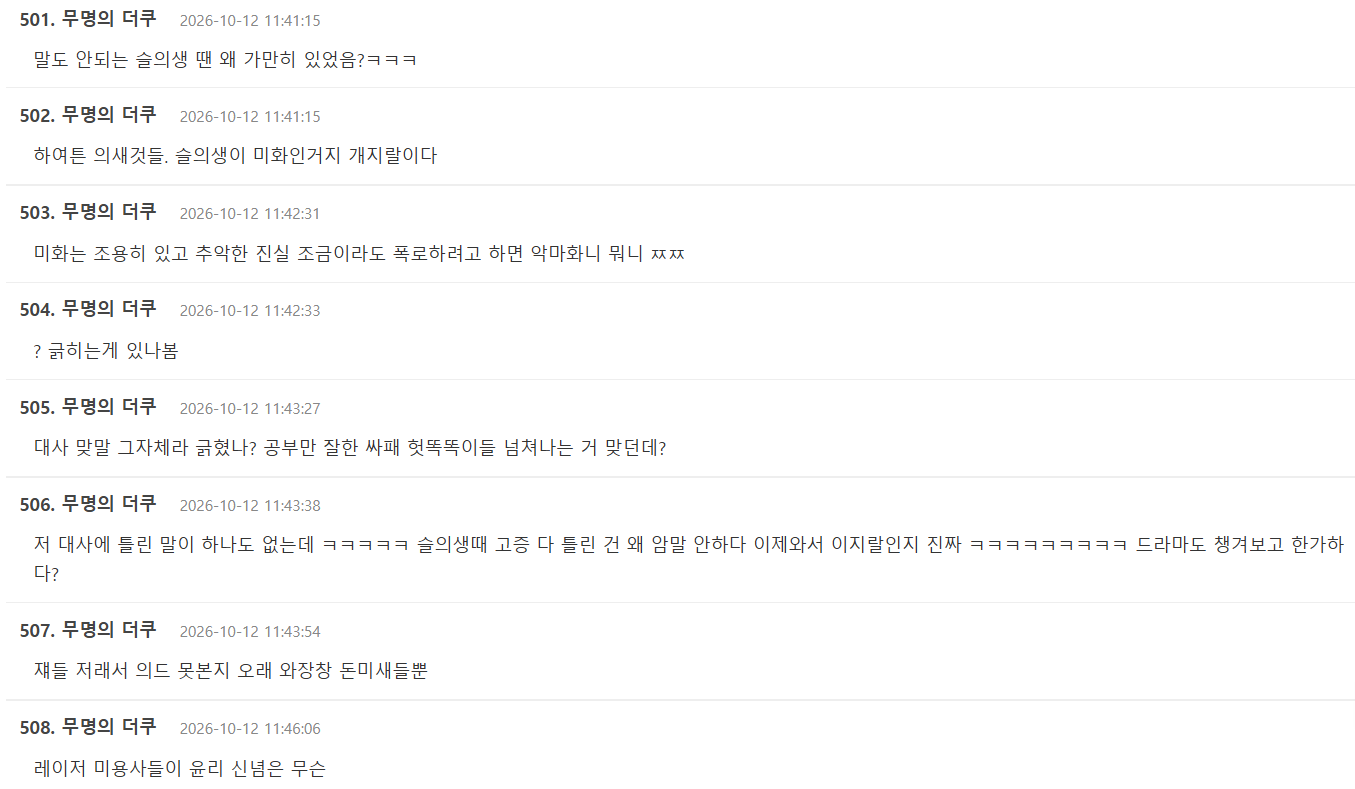
However, this criticism was not universally accepted by netizens. After the content was reposted to the Korean online forum theqoo, many netizens sided with the drama, arguing that doctors should not demand that a work cannot depict problems within the medical system just because it includes negative portrayals.
Some netizens referenced the K-drama “Hospital Playlist” (슬기로운 의사생활), which also focuses on doctors' daily lives, asking, “When we watched ‘Hospital Playlist’ before, didn't some people say that was their own story and resonated with them?” Others commented, “Are other professions always portrayed perfectly in dramas? Is only the medical profession a sacred and untouchable domain?” They argued that medical professionals should not receive special treatment.
Even more netizens directly quipped, “If doctors are complaining, it means this drama got it right,” “I knew doctors would react this way, it feels like it hit a nerve,” and “When doctors were praised to the heavens, why didn't anyone say it was a fantasy drama?” Others compared it to how prosecutors, police, and chaebol are often portrayed as villains in dramas, questioning why criticism of doctors elicits such a strong backlash.
Additionally, some netizens shared their own hospital experiences, stating that after just a few days of hospitalization, one would realize how idealized the daily medical life presented in “Hospital Playlist” is. They even directly said that during their hospital stay, it was the nurses who truly made them feel cared for. These comments further fueled the discussion, making the roles of doctors, nurses, and patients within the medical system a hot topic of online debate once again.
In fact, “Doctor X” achieved impressive ratings after just two episodes, demonstrating its success in capturing audience attention. However, by directly addressing sensitive issues such as medical strikes, doctor-patient relationships, and the professional ethics of medical personnel, the work transcends mere dramatic entertainment. Whether these plotlines are revealing problems within the medical system or overly simplifying reality for dramatic effect has become the focal point of debate between opposing sides on the Korean internet.