BTS (방탄소년단) is expected to draw over 150,000 fans across three shows in Lima, Peru, generating an estimated economic impact of $58.4 million (approximately 80 billion Korean Won). This is a prime example of K-pop stars moving beyond cultural influence to make a tangible contribution to local economies.

K-pop has emerged as a major force in the global cultural industry, demonstrating widespread influence. Overseas concerts by top-tier artists like BTS generate economic value that extends far beyond their fandom, prompting entertainment companies to focus on leveraging star power to conquer global markets. This Peru concert serves as a prime example of K-pop expanding its cultural and economic impact across borders.
According to a report by The Korea Herald, BTS sold out all three shows of their 'Arirang' World Tour at Estadio San Marcos (에스타디오 산 마르코스) in Lima, Peru, from October 9-11, 2026, attracting over 150,000 fans in total. The economic impact of these concerts is estimated to reach $58.4 million. Meanwhile, Deadline reported that A+E Global Media detailed its strategy to commercially leverage the popularity of K-pop artists, from rookies to global stars, by harnessing their "extraordinary power." Furthermore, according to Hankyung (한국경제) and Maeil Business Newspaper (매일경제), Kakao Entertainment (카카오엔터테인먼트) has signed a strategic partnership with the U.S.-based Atlantic Music Group (AMG) to promote K-pop artists' entry into the global market, planning collaboration in music production, distribution, marketing, and fandom building.
https://www.koreaherald.com/article/10899758, https://deadline.com/2026/10/a-and-e-korea-k-pop-stars-oh-my-guard-love-in-sync-1237144368/, https://www.hankyung.com/article/2026100781407, https://www.mk.co.kr/news/culture/12170591페루 콘서트 총 관객 수 15만 명
예상 경제 효과 $58.4M
Perspectives by Stakeholder
BTS and BIGHIT MUSIC: Their goals are to solidify their global fandom, expand artist influence, generate revenue, and enhance brand value. Tours serve as both a direct source of income and a promotional platform.
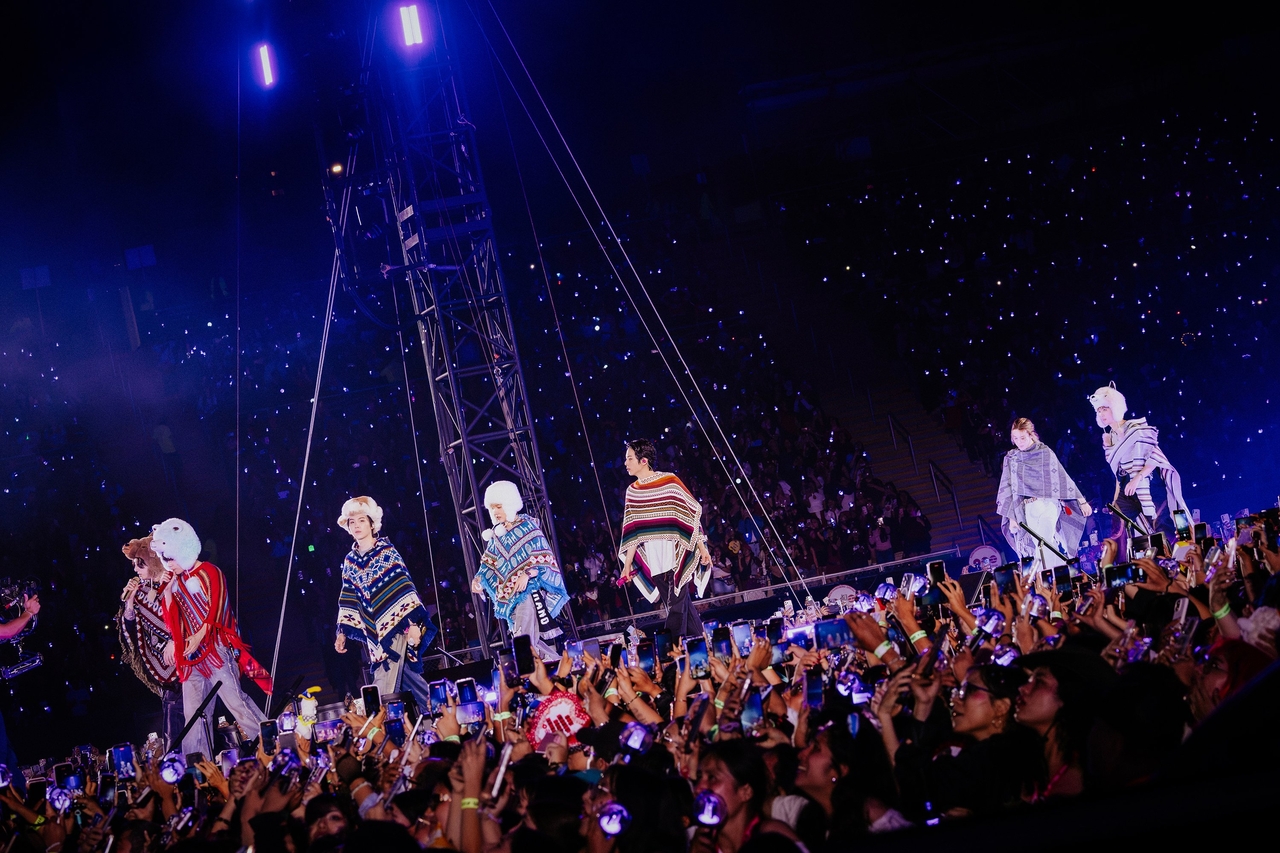
Peruvian Local Economy: Through large-scale concerts, the local economy anticipates direct economic benefits such as attracting tourists, boosting local businesses like hospitality and dining, and creating employment. The estimated $58.4 million economic impact is expected to significantly revitalize the regional economy.
A+E Global Media: A+E Global Media aims to strengthen its competitiveness in the global media market and expand its viewership by leveraging the popularity of K-pop stars for content production and distribution. According to Deadline, they are actively integrating the "extraordinary power" of K-pop stars into their business strategy.
Kakao Entertainment (카카오엔터테인먼트) and Atlantic Music Group (AMG): Through their strategic partnership, they aim to accelerate the global expansion of K-pop intellectual property (IP), create synergy through comprehensive collaboration in music production, distribution, marketing, and fandom building, and expand their influence in the global music market. This strategy involves jointly fostering K-pop super IPs.

Economic Ripple Effect of K-pop's Global Influence
The case of BTS's Peru concert demonstrates that K-pop is more than just a cultural phenomenon; it's a tangible economic driver. According to The Korea Herald, the mobilization of 150,000 attendees and the estimated economic impact of $58.4 million directly invigorate various sectors in the concert host region, including tourism, accommodation, and dining. This suggests that K-pop artists' overseas tours are increasingly playing a dual role: promoting Korean culture in host countries while simultaneously generating concrete economic benefits.
Entertainment Industry's Strategy for Utilizing K-pop Star IP
The global influence of K-pop stars presents new business models for entertainment companies. According to Deadline, A+E Global Media is planning content by leveraging the "extraordinary power" of K-pop stars, showcasing a trend where the popularity of K-pop artists is a core element in content production and distribution strategies. The partnership between Kakao Entertainment (카카오엔터테인먼트) and the U.S.-based Atlantic Music Group (AMG), as reported by Hankyung (한국경제) and Maeil Business Newspaper (매일경제), clearly reveals the industry's strategic move to jointly foster K-pop super IPs and expand them into the global market. This approach aims to maximize the brand value of K-pop stars and create diversified business models.
Individual Brand Value and Independence of K-pop Stars
The success of K-pop groups significantly elevates the brand value of individual members. According to a BBC report, BLACKPINK's Lisa (리사) achieving independent success, such as winning an MTV 'Best Pop' award for her solo activities after leaving her agency YG, demonstrates that K-pop stars are building their own unique influence beyond the group's framework. This individual brand power can lead to various forms of collaborations and activities beyond agency contracts, acting as a factor that increases the overall flexibility and scalability of the K-pop industry. A trend is emerging where individual star influence is rising as a new global IP.
Critical Perspective on K-pop's Commercial Aspects and Sustainability
Behind K-pop's explosive growth lie criticisms regarding its commercialism and concerns about its sustainability. While the economic impact generated by large-scale overseas concerts is clear, the potential for this success to be concentrated on specific artists raises questions about the overall sustainability of the industry. There's also skepticism about whether the success model of top-tier groups like BTS can be universally applied to all K-pop groups. Furthermore, some might argue that K-pop stars' international activities overly prioritize commercial gain over cultural value. These factors remain challenges that the K-pop industry must address in the long term.
[Analysis] K-pop's Complex Status Beyond Cultural Export
The case of BTS's Peru concert illustrates K-pop's evolution from a mere music genre into an industrial ecosystem and a key driver contributing to national economies. As seen with A+E Global Media and the Kakao Entertainment (카카오엔터테인먼트)-AMG partnership, the global influence of K-pop stars is creating comprehensive business models spanning content production, distribution, and marketing, thereby leading changes in the global entertainment market. Concurrently, as exemplified by BLACKPINK's Lisa (리사), the independent brand value of individual stars has grown to surpass that of their agencies, pushing the K-pop industry to explore IP diversification and flexible collaboration structures. However, behind this success lie challenges such as criticisms of commercialism and a success model concentrated on specific groups. K-pop is now navigating a complex current where cultural pride, economic opportunity, and inherent commercial dilemmas are intricately intertwined.
Outlook: Evolution of the K-pop Ecosystem and Key Variables
Moving forward, the K-pop industry will see even more active independent activities by individual stars and strategic alliances between companies. Global partnerships like those involving A+E Global Media and Kakao Entertainment (카카오엔터테인먼트)-AMG will be key drivers in accelerating the entry of K-pop IP into overseas markets. Concurrently, new business models and fandom management strategies will become crucial for sustaining the economic ripple effect of large-scale overseas concerts. How K-pop stars' influence contributes beyond mere entertainment to cultural diplomacy and enhancing national brand value, and whether this growth leads to an overall upward leveling of the K-pop ecosystem rather than being concentrated on a few groups, will be noteworthy variables in the future.