The K-Beauty industry is officially diving into a new era of ingredient innovation, moving beyond PDRN (Polydeoxyribonucleotide) to next-generation high-functional ingredients like Blue Peptides and Azelaic Acid. This shift highlights a continuous drive for technological advancement. For instance, Toun28's (톤28) 'Blue Peptide' raw material costs a staggering 18 million won per kilogram, and US Amazon search volume for Azelaic Acid has surged by 228% year-on-year, proving the global market's intense interest.
K-Beauty's New Challenge: Moving Beyond PDRN
PDRN (Polydeoxyribonucleotide), extracted from salmon, once dominated global beauty trends, gaining significant attention for its skin regeneration and anti-inflammatory benefits. But K-Beauty isn't one to rest on its laurels. The industry is now fiercely competing for leadership in next-generation, highly advanced functional ingredients, focusing on Blue Peptides, Azelaic Acid, and Tranexamic Acid (TXA). This isn't just a simple swap of ingredients; it's a pivotal moment that showcases K-Beauty's capacity for technological innovation to the entire world. (Sisa Journal-e, 2026-09-22)
Blue Peptides, Azelaic Acid, and TXA Emerge as Next-Gen Core Ingredients
Korean cosmetic brands are significantly bolstering their product lines, focusing on Blue Peptides, Azelaic Acid, and Tranexamic Acid (TXA). Notably, Toun28 (톤28) unveiled its 'The First Blue Peptide' line to mark its 10th anniversary. This product incorporates 'Copper Tripeptide-1 (GHK-Cu),' a blend of copper ions and peptides, which gets its 'Blue Peptide' name from the raw material's inherent blue hue. According to Toun28's human application tests, the Blue Peptide cream demonstrated an average improvement of 45.7% across five key indicators: elastic recovery, skin density, cheek volume, surface elasticity, and inner skin elasticity. This potent core ingredient is a high-cost component, priced at approximately 18 million won per kilogram. (Sisa Journal-e, 2026-09-22)
Azelaic Acid is gaining traction for its effectiveness in managing sebum and skin troubles, as well as improving skin tone. The beauty brand Anua's (아누아) 'Azelaic Acid Serum' proved its global popularity by securing the #1 spot in the beauty serum category during Japan Amazon Prime Day this past July. SKIN1004 (스킨1004) also launched its 'Madagascar Centella Azelaic Acid 10 Ampoule' in April, a global-exclusive product specifically designed for the North American, European, and Japanese markets. (Sisa Journal-e, 2026-09-22)
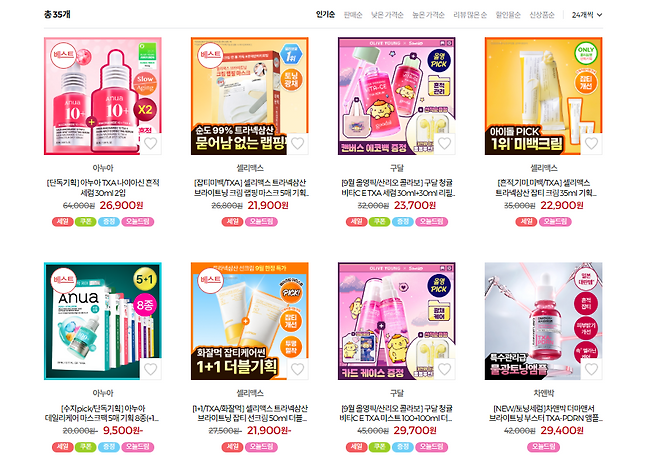
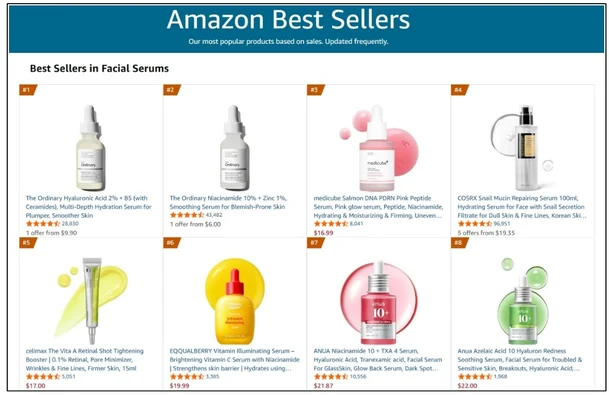
Tranexamic Acid (TXA), used for managing skin hyperpigmentation, is also widely available through products like Medicube's (메디큐브) 'TXA Trace Toning Serum' and Anua's 'Niacinamide 10 TXA 4 Dark Spot Correcting Serum.' Brands such as Celimax (셀리맥스) and CNP (차앤박) have also introduced TXA-infused products through major channels like Olive Young (올리브영, Korea's largest beauty chain). Amorepacific's (아모레퍼시픽) analysis of US Amazon search data from November last year revealed a 228% year-on-year increase in search volume for Azelaic Acid-related keywords and a 121.7% increase for TXA, indicating a sharp rise in consumer interest for high-functional ingredients. (Sisa Journal-e, 2026-09-22)

ODM Companies' Technology: The Core of Ingredient Competition
The K-Beauty ingredient race isn't just about discovering new raw materials; it's expanding into a fierce competition among Original Development Manufacturing (ODM) companies for advanced skin delivery technologies. Kolmar Korea (한국콜마), for example, has identified 'Nobiletin,' a compound derived from tangerine peel, as a potential alternative to retinol for improving wrinkles and elasticity. They are also moving towards commercializing '100% human-like collagen' using microorganisms. Similarly, Cosmax (코스맥스) is researching ways to enhance the stability and skin delivery efficiency of NAD+ ingredients. This involves encapsulating PDRN within exosome particles and utilizing their proprietary 'Lipojet' delivery technology, all in line with the 'Skin Longevity' trend. (Sisa Journal-e, 2026-09-22)
These technological innovations are dramatically increasing the skin absorption rates of novel ingredients like retinol and exosomes, pushing them from an initial 30% to an impressive 70-90%, thereby maximizing the effects consumers experience. An industry insider told Sisa Journal-e, "It's no longer simply about which ingredients you use, but how you combine new materials with proprietary delivery technologies. The synergy between discovering promising materials and advanced formulation technology will be a crucial competitive advantage in the future K-Beauty market." (Sisa Journal-e, 2026-09-22)
기존 피부 흡수율 30%
최대 피부 흡수율 (신기술 적용) 90%
ODM Companies Achieve Robust H1 Performance
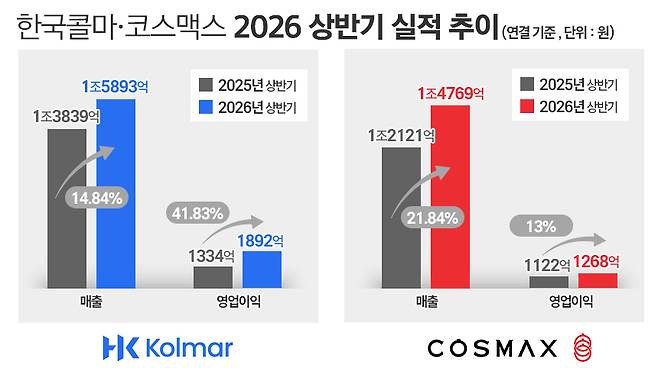
Driven by the development of next-generation ingredients and delivery technologies, ODM companies have reported strong financial results. According to the Financial Supervisory Service's (금융감독원) electronic disclosure system, Kolmar Korea (한국콜마) achieved consolidated revenue of 1.5893 trillion won in the first half of this year (a 14.8% increase year-on-year) and an operating profit of 189.2 billion won (a 41.8% increase year-on-year). Cosmax (코스맥스) also continued its growth trajectory during the same period, recording revenue of 1.4769 trillion won (a 21.8% increase year-on-year) and an operating profit of 126.8 billion won (a 13.0% increase year-on-year). (Sisa Journal-e, 2026-09-22)
Ingredient Innovation Drives K-Beauty Export Boom
This intense competition in ingredients and technology is serving as a crucial factor in elevating K-Beauty's global competitiveness. With the robust export performance of the domestic cosmetics industry, securities firms are consistently raising the target prices for K-Beauty-related companies. According to financial information provider FnGuide (에프앤가이드), Kolmar Korea's (한국콜마) target stock price surged by nearly 40% in the past three months (June 22 to September 22), climbing from 121,789 won to 170,200 won. During the same period, Cosmax's (코스맥스) target price increased by 22.89% to 306,737 won, and Cosmecca Korea's (코스메카코리아) rose by 15.45% to 135,200 won. (Maeil Business Newspaper, 2026-09-27)
Kim Myung-joo (김명주), a researcher at Korea Investment & Securities (한국투자증권), shared with Maeil Business Newspaper (매일경제) that "Despite an unfavorable export environment, including a strong won and rising shipping and fuel costs, Korean cosmetic sales have consistently set new all-time highs since the second half of the year." Kim Myung-joo further analyzed, "Considering that the US shopping season officially kicks off in October, it's highly probable that strong Korean cosmetic exports will lead to increased orders for Cosmax." This clearly demonstrates that K-Beauty is solidifying its position in the global market not just through the popularity of Hallyu (Korean Wave), but also with its unique technological prowess and innovative ingredients. (Maeil Business Newspaper, 2026-09-27)
K-Beauty's ingredient innovation, which began with PDRN, is continuously evolving with breakthroughs like Blue Peptides and Azelaic Acid, fundamentally reshaping the global beauty market. This ingredient competition, powered by the cutting-edge technology of ODM companies, is expected to further solidify K-Beauty's status as a frontrunner in the global beauty industry. Ultimately, this combination of advanced technology and positive market reception will undoubtedly fuel K-Beauty's sustained growth and expanding exports. (Sisa Journal-e, 2026-09-22, Maeil Business Newspaper, 2026-09-27)



![[K-Beauty Ranking] Musinsa Beauty Analyzes Popularity of Ampoules and Serums by Ingredient](/_next/image?url=https%3A%2F%2Fkagit-media.atreez.cc%2Feditorial%2Fscout%2Fcmuhg2o78045emw1d6iq48aja%2F10260b6c6cf3.jpg&w=1920&q=75)