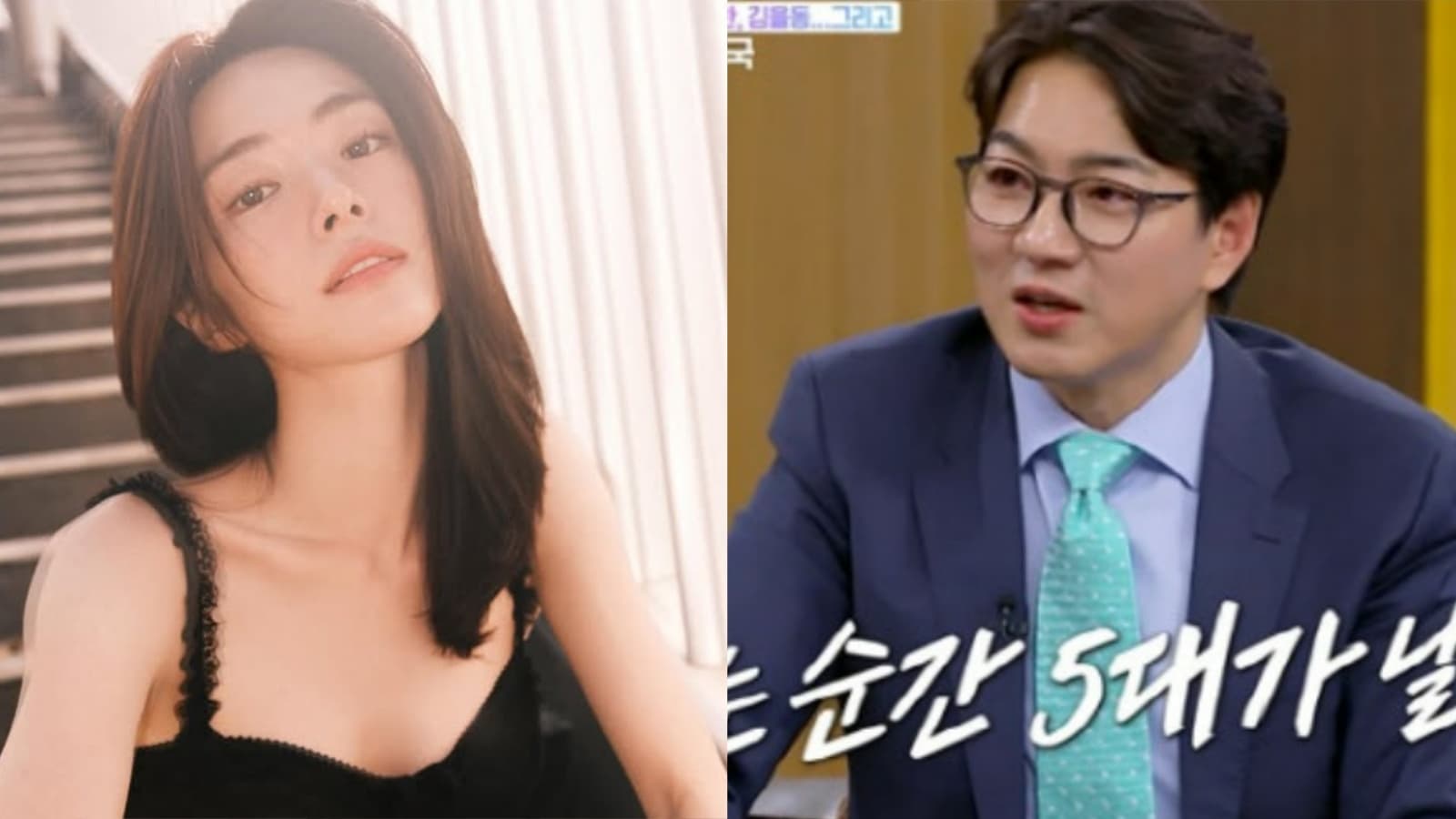
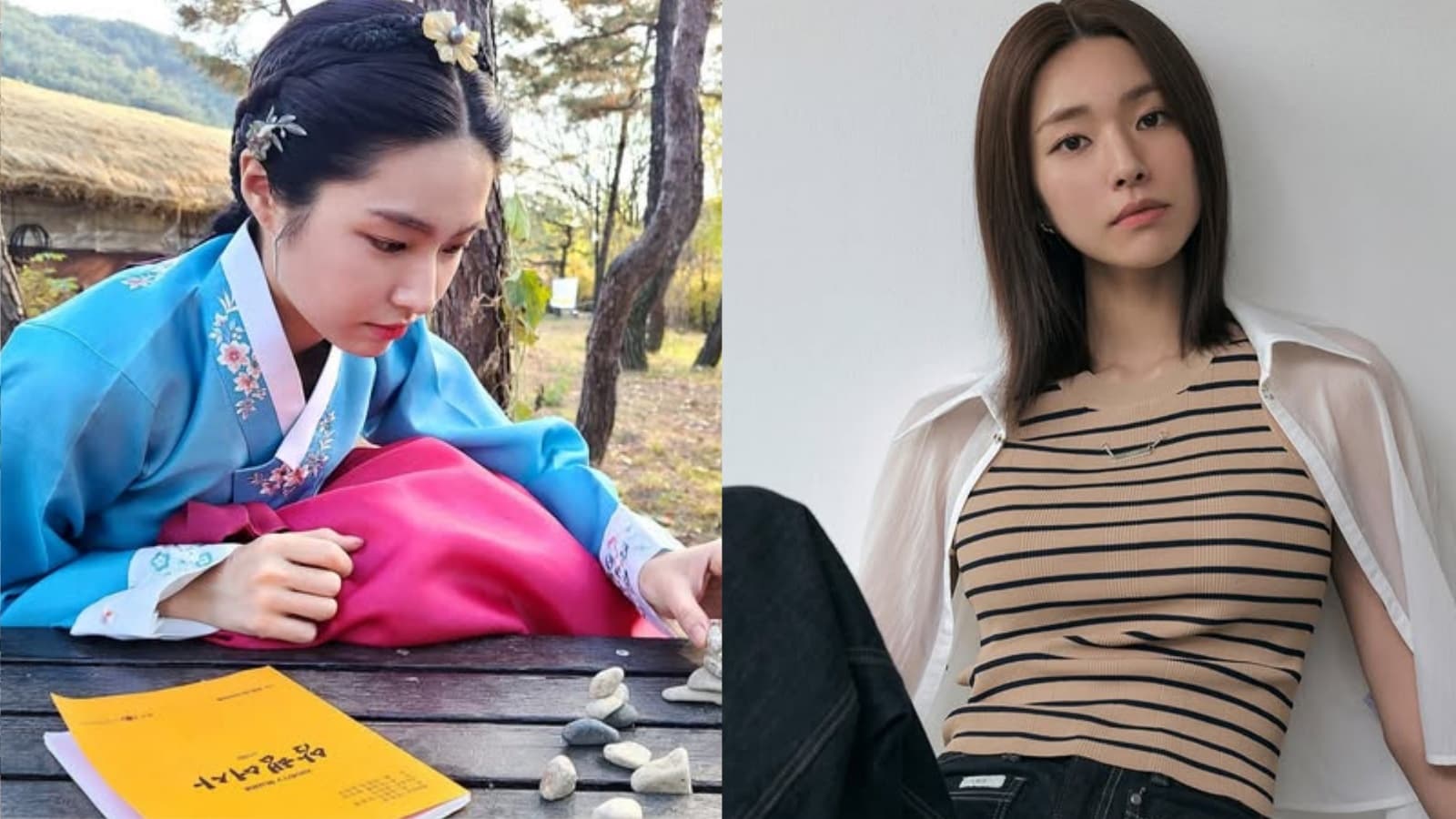
South Korean actress Ha Young (하영) recently appeared on a variety show to promote her new drama, “My Sweet Mobster.” She had previously mentioned multiple times that she came from a “four-generation family of doctors.” However, her family background has recently come under scrutiny, with allegations surfacing that her great-grandfather, Ahn Sang-ho (안상호), was involved in pro-Japanese activities. Past controversies involving her grandfather and her mother's previous remarks about flaunting wealth, including mentioning “200 million Korean won hidden in a safe,” have also resurfaced, fueling an ongoing controversy.
Despite Ha Young publicly issuing a handwritten apology, admitting to past mistakes in her words and actions, the controversy has not subsided. Instead, criticism has escalated from her past statements about her family background to demands for her withdrawal from her new drama, with some even calling for a complete ban on her entertainment activities.
As Ha Young’s family controversy continues to unfold, other Korean celebrities who previously faced similar issues due to their ancestors' alleged pro-Japanese activities have also been revisited by netizens. Notably, the family backgrounds and ancestral histories of actors Kang Dong-won (강동원) and Lee Ji-ah (이지아) have recently been compiled into videos circulating online. However, the reactions from Korean netizens to their situations differ significantly from the response to Ha Young.
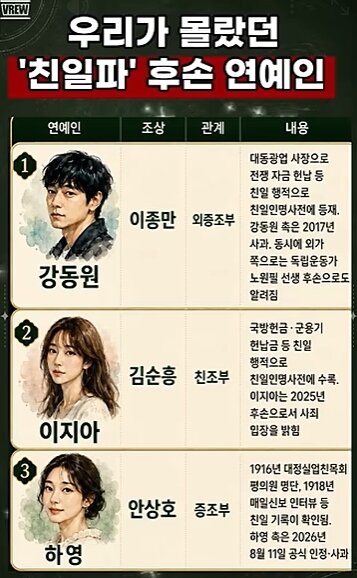
First, Kang Dong-won's maternal great-grandfather, Lee Jong-man (이종만), served as the president of Daedong Mining and was accused of pro-Japanese activities, including donating war funds, leading to his inclusion in the “Dictionary of Pro-Japanese Figures.” In 2017, after Lee Jong-man's pro-Japanese history came to light, sparking controversy, Kang Dong-won personally issued a public apology. However, Kang Dong-won's maternal family is also descended from the independence activist Noh Won-pil (노원필), presenting a contrasting aspect of his family background.
In this wave of discussion, Lee Ji-ah's family history has garnered even more attention. Her grandfather, Kim Soon-heung (김순흥), donated defense funds and military aircraft funds during the Japanese colonial period, and these records are included in the “Dictionary of Pro-Japanese Figures.”
Last year, after her grandfather's pro-Japanese history gained attention, Lee Ji-ah's agency released a statement on her behalf, saying, “I apologize for the trouble caused by this shameful historical record.” She also apologized to the public as a descendant.

Furthermore, Lee Ji-ah revealed more about her family situation. She stated that she had been living independently since the age of 18 and had never received any financial support from her parents since then. She also admitted that due to complex family issues, she had cut ties with her parents for over 10 years.
She also disclosed that her grandfather passed away when she was two years old, so she had almost no memories of him and was completely unaware of his involvement in pro-Japanese activities during her upbringing. It wasn't until 2011, when she first learned about it through news reports, that she repeatedly visited the Institute for Research in Collaborationist Activities to verify the truth and actively learn about the related history. After investigation, Lee Ji-ah confirmed that her grandfather indeed had records of such donations. She stated that even considering the historical context of the time, “these actions cannot be justified in any way.”
Regarding the land in Anyang, which is at the heart of this controversy, Lee Ji-ah clearly stated her position, believing that if the land was indeed acquired during the Japanese colonial period, “it should be returned to the state.”
Additionally, Lee Ji-ah proactively clarified circulating rumors online. She emphasized that she had never made any statements about her grandfather in the past, nor had she used her family background to promote herself, nor had she actively shaped her family image through related reports.
This stance unexpectedly garnered widespread support from Korean netizens, with many praising her courage in confronting her family history. One netizen commented, “This is the first time I’ve seen a famous celebrity so clearly and explicitly state their position on being a descendant of a pro-Japanese figure.”
Another netizen wrote, “Very brave, and her stance is very clear. It must have been difficult, but she still bravely explained everything to everyone. Thank you so much, I will support you with all my might.”
Some netizens even admitted to having held prejudices against her because of her pro-Japanese ancestry. “Before, I looked at her with bias because she was a descendant of a pro-Japanese figure, but after learning more, I found out she's a wonderful woman! I support her.” Another person thought, “Lee Ji-ah didn't choose to be born into this family. What she has done now is already her best effort.”
Some netizens even noticed her statement about “becoming independent at 18,” commenting, “If she became independent at 18, she must have already been married then? So she got married and moved to the U.S., then started living independently. I'm really glad she's willing to clarify the situation and state her position now.”
In stark contrast to Ha Young, who faces strong backlash and calls for her removal from projects and even a ban due to her family's historical controversy, Lee Ji-ah's public approach to her grandfather's pro-Japanese history has earned her considerable approval from Korean netizens, creating a striking comparison between the two incidents.