Korean actress Jung Young-joo (정영주) often portrays powerful and assertive female characters in dramas. While not always in leading roles, her distinct personality and solid acting skills consistently leave a deep impression, earning her a reputation among many viewers as a “masterful supporting actress.” With over 30 years in the industry, she began her career as a veteran musical theater actress and has recently gained wider international recognition through her role in the hit drama Lovely Runner.
In Lovely Runner, Jung played Park Bok-soon, the mother of female lead Im Sol (Kim Hye-yoon), affectionately known as “Sol’s mom.” Park Bok-soon is a single mother raising her child alone, characterized by her straightforward, lively personality and intense maternal love. Jung’s natural portrayal, which was at times humorous and at other times brought tears with its depiction of mother-daughter affection, made her one of the drama’s most popular supporting characters.
Off-screen, Jung recently appeared on a program where she spoke candidly about her journey raising her son. She revealed that her son was diagnosed with Attention-Deficit/Hyperactivity Disorder (ADHD) at a young age. Throughout his growth, he faced scrutiny due to behaviors different from others, leading her as a mother to endure immense parenting stress.
On the latest episode of KBS 2TV’s Malja Show, which aired on the 7th, Jung appeared as a guest and recounted her son’s experiences from childhood to adulthood. She disclosed that her son was diagnosed with ADHD when he was young. “Because this condition doesn’t have a very clear medical definition, and there’s a line between normal and disorder, it can sometimes cause inconvenience in social life, and people around him tend to view these behaviors negatively,” she explained.
Jung admitted that as the mother closest to her child, constantly needing to care for him, she experienced significant pressure back then. She recalled that her son would sometimes suddenly bolt when he was little. “I never knew when he might suddenly run into the street, so when I was raising him, I even put a leash on him, similar to what you’d use for a large dog,” she shared.
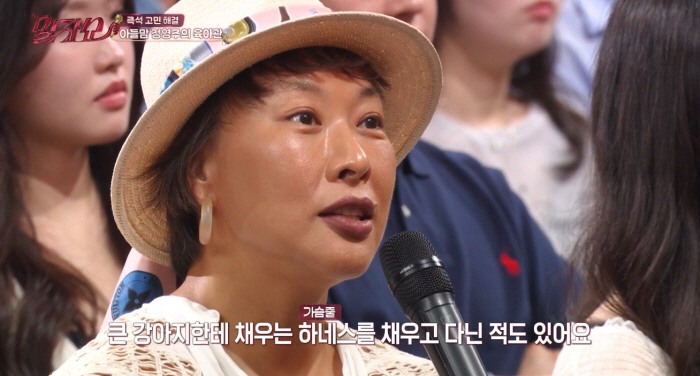
Beyond safety concerns, mother and son frequently clashed due to differing ways of thinking. She stated that when her son’s ideas didn’t align with conventional views, they often collided in opinions and emotions, sometimes escalating into intense arguments.
However, despite the challenges of parenting, Jung consistently strived to understand her son’s perspective. She confessed, “I truly couldn’t handle it alone, so whenever there was a place to seek advice, I would go and learn.” She revealed that they often talked and discussed things, sometimes arguing for a long time over a single issue. “Sometimes things just couldn’t be resolved and had to be set aside for a while, but most of the time, I tried to listen to what my child wanted to say.”
The pivotal moment that changed Jung’s parenting approach occurred when her son was seven years old. She was going through a low point in her life, overwhelmed by personal setbacks. Unexpectedly, her son approached her with a dirty rag and said, “Mom, it looks like there’s something in your eye,” then gently wiped her eyes himself.
Recalling this memory, Jung became emotional. She stated, “That moment brought me to my senses. I was inspired by him, and I learned so much from my child. It became a crucial turning point for me to change my parenting style.”
In addition to the parenting challenges during his childhood, her son was involved in a severe car accident in his second year of middle school. He was riding his bicycle when the accident occurred, resulting in serious injuries such as an orbital fracture. He required approximately 1,400 stitches and a long period of hospitalization for treatment. Jung revealed that during his hospital stay, her son even comforted her, his mother. “Sometimes he was mature enough to console me,” she said.
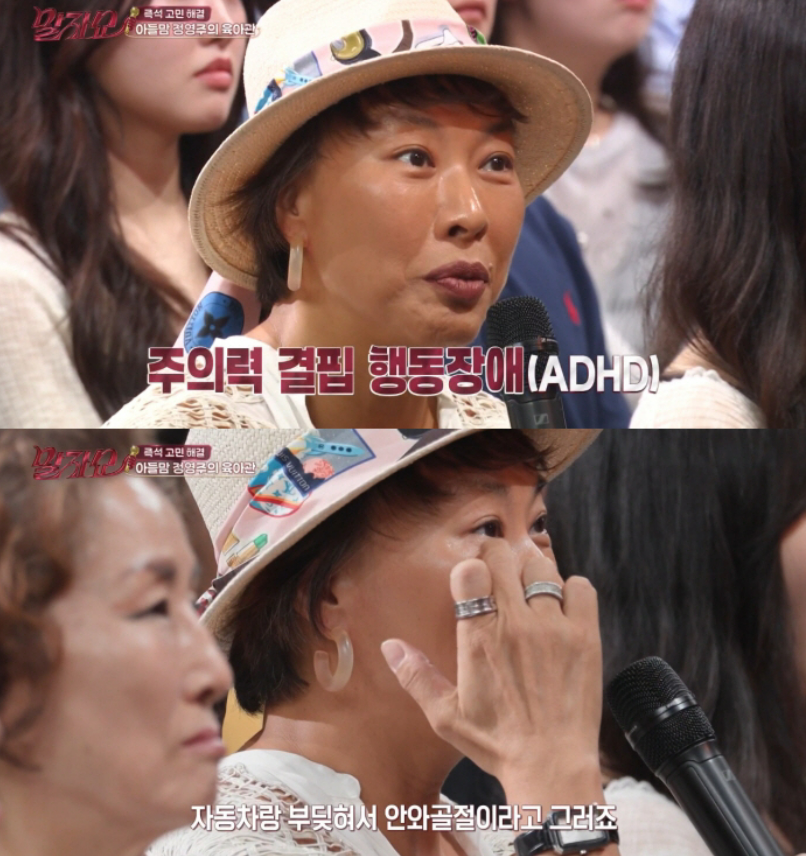
What impressed her most was that even after losing teeth due to the accident, her son did not give up his passion for Beatbox. She lamented, “If I had been in that situation, I probably would have given up, but he continued to practice even without teeth.” She added, “I feel like I’ve never been so dedicated to anything, so it was actually my child who inspired me.”
Today, her son is an adult, living independently, and continues to be involved in music. When discussing her son’s journey, Jung expressed not only a mother’s heartache and worry but also immense pride. As she accompanied him through his growth, she gradually realized that she wasn’t just teaching him how to grow, but also learning many life lessons from her son.