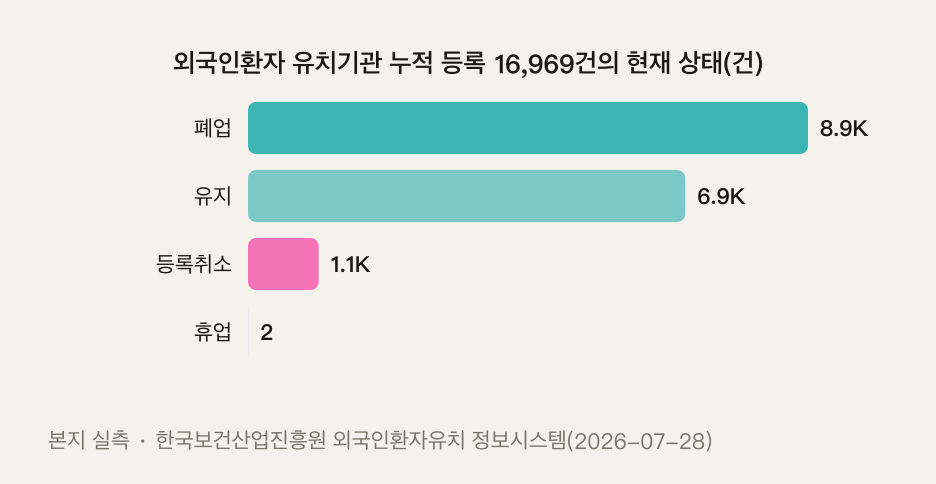
Social media posts targeting foreign consumers seeking cosmetic procedures in Korea often include the phrase 'Korean Government Registered Foreign Patient Attraction Business Operator' along with a registration number. However, this designation cannot always be taken at face value. A Kagit.kr analysis of the Korea Health Industry Development Institute's (KHIDI) foreign patient attraction information system, as of July 28, 2026, revealed that while there have been a cumulative 16,969 registered entities, only 6,947 are currently in 'maintained' status. A total of 8,897 registrations were classified as 'closed,' and 1,123 were 'canceled' due to sanctions or other reasons, meaning expired registrations outnumbered active ones.
The 6,947 'maintained' registrations consist of 4,195 foreign patient attraction medical institutions and 2,752 foreign patient attraction businesses. In other words, the fact that a registration number was once issued is entirely different from the registration still being active. While registration status is one of the few official checks consumers can perform before traveling, its scope is narrower than many might assume.
Registration: A 'Requirement-Fulfilling System,' Not a Permit
The legal basis for this system is Article 6 of the 「Act on Support for Overseas Expansion of Medical Services and Attraction of Foreign Patients」. Medical institutions and non-medical businesses intending to attract foreign patients must register with the city or provincial governor after meeting specific legal requirements. Legally, these are termed 'foreign patient attraction medical institutions' and 'foreign patient attraction businesses,' respectively. Registration certificates are also issued by city or provincial governors. It is crucial to understand that this is not a permit system where governors approve based on discretion, but rather a structure where registration is granted upon meeting statutory requirements.
- Attraction Medical Institutions — Must employ at least one specialist for each medical department intending to attract foreign patients (excluding certain specialties defined by presidential decree). They must also be enrolled in medical malpractice liability insurance or a medical mutual aid association. The annual compensation limit is 100 million KRW or more for clinic-level and hospital-level facilities, and 200 million KRW or more for general hospitals.
- Attraction Businesses — Must subscribe to guarantee insurance as prescribed by the Ministry of Health and Welfare (MOHW), possess capital exceeding a certain amount prescribed by MOHW decree, and establish an office in Korea. While the law itself does not specify amounts, the enforcement rules set the guarantee insurance and capital at 100 million KRW or more, respectively.
The validity period for registration is three years from the registration date (Article 6, Paragraph 6). To continue attracting patients, renewal must be completed before expiration. KHIDI and local government guidelines require 'completion of renewal procedures between two months and 20 days before expiration.' The '20 days' refers to the processing time for registration, not a legally mandated deadline, and should not be interpreted as such.
Attracting foreign patients without registration can result in imprisonment for up to three years or a fine of up to 30 million KRW (Article 28). The government explicitly considers 'operating foreign-language websites, smartphone applications, and SNS' as attraction activities. While providing simple information in English, an international common language, is not considered an attraction activity, offering appointment booking, consultations, or specialized information targeting foreign patients falls under attraction activities, according to KHIDI. Accounts that provide information on procedures and accept reservations in Japanese or Chinese are, by this standard, engaging in attraction activities and thus subject to registration.
How to Verify Registration Status Yourself
The inquiry portal is the Foreign Patient Attraction Information System (medicalkorea.or.kr), operated by KHIDI, an agency under the Ministry of Health and Welfare. However, there's one limitation to be aware of before starting: the system is Korean-only. There are no English, Chinese, or Japanese interfaces. You will need to use your browser's translation function or seek assistance from someone who can read Korean. For an English-supported channel, the same institute operates the Foreign Patient Illegal Attraction Reporting Center.
- Open '유치기관 현황조회' (Attraction Institution Status Inquiry) on the medicalkorea.or.kr homepage. If you know the hospital or company name, enter it in the '기관명' (Institution Name) field. The first thing to check is the '상태' (Status) result — it must be '유지' (Maintained) for the registration to be currently valid. '폐업' (Closed), '등록취소' (Registration Canceled), or '휴업' (Suspended) all indicate that the entity cannot currently attract patients. '등록취소' specifically means the registration was revoked due to sanctions.
- If you don't know the company name but have only the registration number, enter the last four digits of that number into the '기관 등록번호' (Institution Registration Number) field to perform a reverse lookup. The search will not work if it's not four digits.
- Compare the company name, region, and institution type displayed in the reverse lookup results with what the entity has stated. Since the same four digits might correspond to both medical institutions and attraction businesses, differentiate using '기관구분' (Institution Type). If the institution type is blank, it is an attraction business.
- If you know the entity's business registration number, enter all 10 digits into '등록기관 조회' (Registered Institution Inquiry). This will provide a textual description of whether it is maintained, closed, suspended, or unregistered.
- If you wish to check the quality of the hospital itself, search for it in '평가인증기관 현황조회' (Accredited Institution Status Inquiry).
- If the stated information differs from the actual registration, or if registration cannot be confirmed, report it to the 신고센터 (Reporting Center) at medicalkorea.or.kr/kmediwatch (available in Korean and English).
There's a common point of misunderstanding here: the inquiry results do not display the full registration number. The status inquiry result table includes items like number, status, company name, representative name, contact information, institution type, region, address, and target countries for attraction, but the registration number field is absent even when downloaded as an Excel file. The registration number is merely a search condition, not an output value. Therefore, actual verification involves reverse-searching with the last four digits and comparing the resulting company name and region with the entity's explanation, rather than reconfirming the entire registration number on screen. Any discrepancy is a red flag.
It's also helpful to understand the limitations of each menu. '등록기관 조회' (Registered Institution Inquiry) requires the business registration number, making it unusable if the entity does not disclose it. For contact information in the status inquiry, the last digits of mobile phone numbers are masked. If you want an additional verification channel, you can check the website of the relevant city or province. When a city or provincial governor issues a registration certificate, they are also required to post the registration details on their respective website.
The Context of This Registration: Market Scale
According to 2025 statistics released by the Ministry of Health and Welfare on April 24, 2026, the number of foreign patients who visited Korea reached 2.01 million (2.72 million patient visits), surpassing 2 million annually for the first time since data collection began in 2009. The MOHW explained that the number showed 'a twofold increase each year for three years,' with 610,000 in 2023, 1.17 million in 2024, and 2.01 million in 2025. The cumulative number of unique foreign patients is 7.06 million.
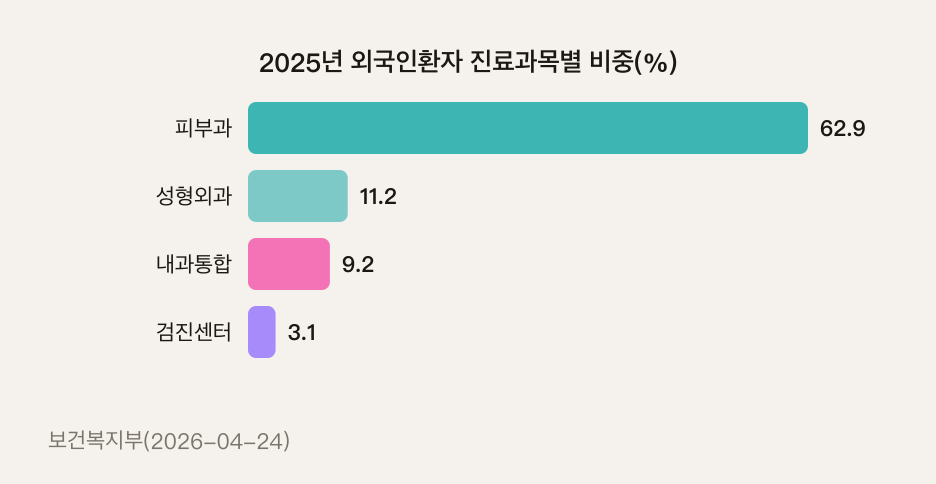
By medical department, dermatology accounted for the largest share at 1.313 million patients, or 62.9% of the total. This was followed by plastic surgery with 233,000 patients (11.2%), integrated internal medicine with 192,000 patients (9.2%), and health check-up centers with 65,000 patients (3.1%). By type of medical institution, clinic-level facilities accounted for 87.7%, indicating that the demand for foreign patient care is concentrated in local clinics rather than large hospitals.
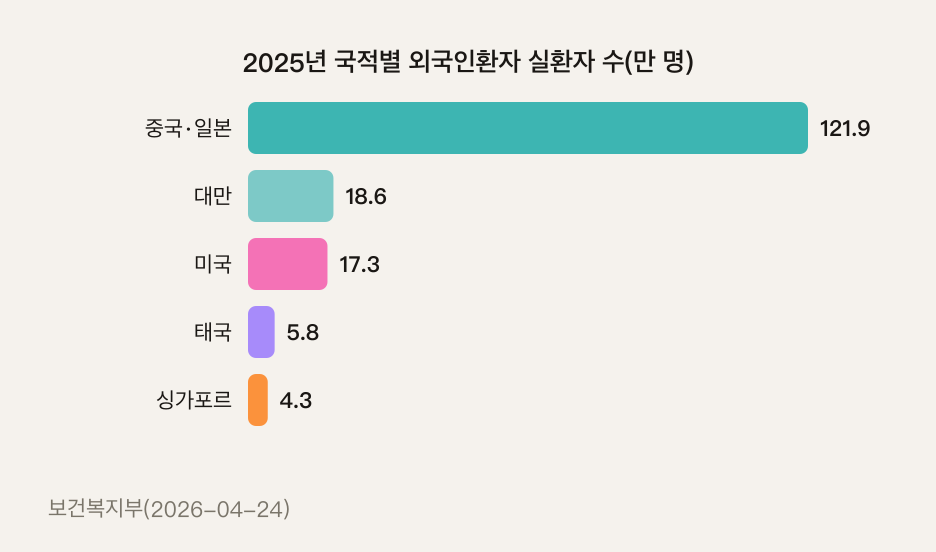
By nationality, China and Japan combined accounted for 1.219 million patients, or 60.6% of the total. The MOHW only released combined figures for these two countries, so individual patient numbers are unavailable. Taiwan followed with 186,000 patients (9.2%), showing the second-highest growth rate at 122.5% year-on-year, after China (137.5%). The United States had 173,000 patients (8.6%), Thailand 58,000 (+52.3%), and Singapore 43,000 (+62.1%). The MOHW attributed this trend to a combination of increased demand for dermatology-focused cosmetic and non-surgical medical services, China's visa-free policy, expanded flights, and a recovery in tourism demand.
Regional concentration is also evident. Seoul attracted 1.76 million patients, accounting for 87.2% of the total. The MOHW directly cited the concentration of registered medical institutions in Seoul (2,555 institutions in 2025, 62.5%) as a reason. As of July 28, 2026, our own analysis of the inquiry system showed that out of 4,195 'maintained' foreign patient attraction medical institutions, 2,643 (63.0%) were located in Seoul. However, this statistic itself has limitations. The MOHW's figures are based on performance reports submitted annually by registered attraction medical institutions, meaning patients who enter through unregistered channels are not captured.
What Registration Does Not Guarantee
KHIDI explains the purpose of the registration system as 'preventing the disruption of the domestic medical market order due to indiscriminate attraction activities, preventing the qualitative decline of public medical services due to excessive competition, and preventing the proliferation of unqualified medical institutions and attraction businesses.' Neither KHIDI's registration system guide nor Article 6 of the law's registration requirements include any content about evaluating the quality of individual procedures or the proficiency of medical staff. The assessment focuses on minimum human and financial requirements and documentation, such as the employment of specialists, insurance enrollment, guarantee insurance, capital, and office space. Disqualification reasons for registration are limited to past convictions for violating this law.
Mechanisms for scrutinizing quality and patient safety are provided separately, not through registration. This is the Foreign Patient Attraction Medical Institution Accreditation System (KAHF), based on Article 14 of the same law. It targets registered medical institutions that wish to be accredited, involving an on-site inspection by the Korea Institute for Healthcare Accreditation and review by KHIDI's Accreditation Deliberation Committee. The evaluation covers three categories of 'foreign patient specialized systems' (attraction performance and operating system, specialist employment, patient rights respect, and medical dispute prevention) and five categories of 'patient safety systems' (patient safety assurance activities, patient care, drug management, infection control, and facility/environment management). The accreditation is valid for four years. This indicates that the government has separated registration and accreditation into different tiers.
As of July 28, 2026, our inquiry found 26 accredited medical institutions nationwide. Compared to the 4,195 'maintained' foreign patient attraction medical institutions at the same time, this represents 0.6% by our calculation. Not being on the accreditation list does not mean a hospital is bad. However, it is clear that the 'registration' designation does not automatically mean 'the state has reviewed its quality.'
Registration is also a snapshot in time. KHIDI's reporting center guidance addresses cases where a specialist was present at the time of registration but is no longer there. The answer is not that the registration automatically becomes invalid, but that it is subject to a corrective order (Article 22, Paragraph 2) and requires a change application. The fact that a registration number is active does not mean that a specialist is currently in that medical department.
Nor does registration provide immunity. A judgment released by the Jeju District Court (2025 Guhap 691) shows that a clinic registered as a foreign patient attraction medical institution was criminally penalized for receiving 17 patients introduced by two unregistered Chinese individuals, to whom it paid a percentage of the medical fees as commission. The competent local government canceled the registration on December 15, 2025, based on Article 24, Paragraph 1, Subparagraph 4 of the Medical Overseas Expansion Act, and the court dismissed the plaintiff's request for cancellation. The 1,123 'registration cancellations' mentioned earlier fall into such cases. KHIDI's reporting center categorizes online violations into two types: one is attraction activities by an unregistered institution (Article 6), and the other is providing false information that differs from the registered medical department or location (Article 9). If an institution is registered but the content in its posts differs from the registration details, it is also a violation. Notably, foreign-language medical advertisements themselves are only permitted in duty-free shops, international airports, and trade ports (Article 15, Paragraph 1).
Pre-Departure Checklist
- Is the 'Status' in the inquiry 'Maintained'? — There are also 'Closed,' 'Registration Canceled,' and 'Suspended' statuses. Out of 16,969 cumulative registrations, only 6,947 are maintained.
- Do the company name and region obtained by reverse-searching the last four digits of the registration number match the entity's explanation?
- Is the institution type a medical institution or an attraction business? — This differentiates whether the entity is a hospital or a referral business.
- Is the hospital you plan to visit on the accreditation list (26 institutions as of July 28, 2026)?
- Are the contents and conditions of services provided, dispute resolution procedures, and personal information protection details posted in English documents within the business premises or medical institution? — This is an obligation imposed on registered institutions by Enforcement Rule Article 7.
- If you suspect a problem, report it to the Reporting Center (medicalkorea.or.kr/kmediwatch). It supports Korean and English, and investigation results are forwarded to the relevant local government. Anonymous reports are not accepted.
※ This article is for informational purposes only and is not an advertisement for specific medical institutions or procedures. The decision to undergo a procedure and its effects may vary by individual; please make an informed decision after sufficient consultation with medical professionals.