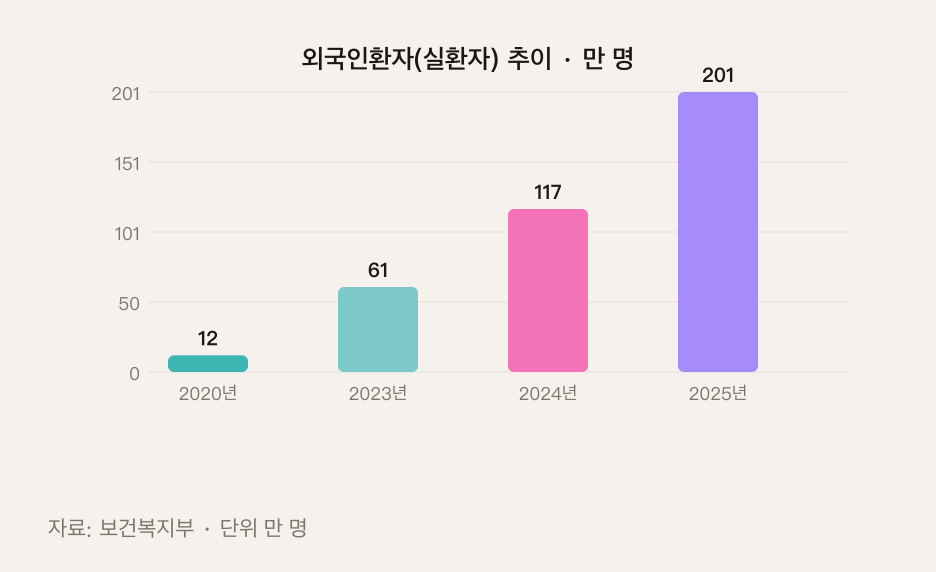
The number of foreign patients in Korea, as compiled by the Ministry of Health and Welfare (MOHW), hit a low of 120,000 in 2020 due to the COVID-19 pandemic. This figure then surged, reaching 610,000 in 2023, 1.17 million in 2024, and 2.01 million in 2025. This represents approximately a 17-fold increase from the low point, or a doubling each year over three years since the pandemic (this publication's calculation). The cumulative number of patient visits reached 2.72 million, with a total of 7.06 million foreign patients since data collection began in 2009. The MOHW also released an analysis by the Korea Institute for Industrial Economics & Trade, projecting medical tourism expenditures to reach 12.5 trillion won by 2025.
So, how do these patients access hospitals in Korea? In 2015, Korea established a registration system through the 「Act on Support for Overseas Expansion of Healthcare Services and Attraction of Foreign Patients」 (hereinafter, the Act on Overseas Healthcare Expansion) to regulate the attraction of foreign patients. Attracting foreign patients without registration is punishable by up to three years in prison or a fine of up to 30 million won (Article 28).
Medical Service Act Prohibits, This Act Sets a Threshold
Article 27, Paragraph 3 of the Medical Service Act prohibits acts of introducing, brokering, or enticing patients to medical institutions or medical professionals for profit, as well as instigating such acts. However, the same paragraph includes exceptions, with Subparagraph 2 specifying 'acts for attracting foreign patients who are not subscribers or dependents under Article 109 of the 「National Health Insurance Act」 (excluding foreign nationals residing in Korea as prescribed by the Ordinance of the Ministry of Health and Welfare).' This means that attracting foreign patients is an exception to the prohibition on introduction and brokering stipulated by the Medical Service Act.
Therefore, a separate law was necessary. The Act on Overseas Healthcare Expansion requires those who wish to attract foreign patients to register with the city/provincial governor (Article 6), and punishes those who attract patients without registration under Article 28. Based solely on the structure of the provisions, the penalty directly applicable to unregistered patient attraction is this article, not the Medical Service Act. However, it is not explicitly stated in the text of the provision whether the exception in Article 27, Paragraph 3, Subparagraph 2 of the Medical Service Act applies only to 'registered entities' — this publication has not found any precedent that has ruled on this issue.
The legal definition of a 'foreign patient' is based on health insurance eligibility, not nationality. Article 2, Subparagraph 2 of the Act on Overseas Healthcare Expansion defines a foreign patient as a foreign national who is not a subscriber or dependent of the National Health Insurance, excluding foreign nationals residing in Korea. Readers from Taiwan, Hong Kong, and Japan who enter Korea for tourism and receive medical procedures fall under this definition.
Actual Sanctions Stipulated by Law
On May 12, 2026, an amended version of this law (Act No. 21112) and its enforcement decree (Presidential Decree No. 36284) came into effect simultaneously. The amendment to the law primarily involved adding Paragraph 2 to Article 11, which states that medical institutions attracting foreign patients 'may include information such as the method and process of attracting each foreign patient, and whether a foreign patient attraction business operator introduced or brokered them' when reporting their previous year's business performance. The legislative rationale published by the Ministry of Government Legislation states that the amendment aims to 'strengthen management of overseas intermediaries and foreign patients.' However, the wording is 'may include,' not 'must include,' making it a discretionary provision. The amendment to the enforcement decree, which also took effect on the same day, allows the Minister of Health and Welfare to delegate the task of surveying fees and medical expenses to a designated institution.
This publication downloaded the full text of the law, its enforcement decree, and enforcement rules, as well as all amendments to the law from its enactment in 2015 to its promulgation in May 2026, and performed a word-by-word search. Terms such as 'public announcement,' 'confiscation,' and 'collection' did not appear even once. There are also no provisions for administrative dispositions that suspend business for a certain period, nor are there administrative disposition criteria tables that divide such periods, anywhere in the law, enforcement decree, or enforcement rules. Furthermore, this law provides no basis for a system to disclose the name, age, or address of individuals convicted of offenses. The sanctions under this law consist of two criminal penalty provisions, a joint penal provision, and administrative fines, penalties, corrective orders, registration cancellations, and cancellation of certification for certified institutions.
| Provision | Target | Sanction |
|---|---|---|
| Article 28 (Criminal) | One who attracts foreign patients without registration | Up to 3 years imprisonment or up to 30 million won fine |
| Article 29 (Criminal) | One who makes false overseas expansion reports, fails to comply with overseas healthcare expansion corrective orders (Article 22, Paragraph 1), registers through false/fraudulent means, transfers/lends or receives transfer/loan of name/registration certificate, impersonates certification, violates medical advertising regulations | Up to 1 year imprisonment or up to 10 million won fine |
| Article 30 (Criminal·Joint Penal) | Corporation or individual business owner to which the offender belongs | Fine specified in the relevant article (exemption if due diligence and supervision were exercised) |
| Article 26 (Administrative·Monetary) | One who engages in unregistered attraction activities, receives fees exceeding the publicly notified rate | Administrative fine up to the full amount of sales during the violation period (up to 1 billion won if calculation is difficult) — may be imposed |
| Article 31, Paragraph 1 (Administrative·Monetary) | Failure to post registration certificate/patient rights, false reporting of business performance, use of similar names | Administrative fine up to 5 million won |
| Article 31, Paragraph 2 (Administrative·Monetary) | Failure to report changes/suspension/closure of business, fraudulent certification, refusal/obstruction of reports/inspections | Administrative fine up to 2 million won |
| Article 22, Paragraph 2 (Administrative·Order) | Medical institutions/business operators attracting patients (lacking registration requirements, failing to post registration certificate, exceeding bed capacity, failing to report/false reporting) | Corrective order for a specified period — may be issued |
| Article 24, Paragraph 1 (Administrative·Registration) | Medical institutions/business operators attracting patients (11 reasons) | Registration cancellation + cannot reapply for registration for 1 year from cancellation date. Only Subparagraph 1 (false/fraudulent registration) is mandatory, the other 10 reasons are discretionary |
| Article 24, Paragraph 1, Subparagraph 4 (Administrative·Registration) | Medical institution attracting patients that received introduction/brokerage from a non-patient attraction business operator | Registration cancellation (discretionary) — basis for disposition in Jeju 2025 Guhap 691 case |
| Article 27 (Incentive) | One who reports/accuses violators | Reward up to 10 million won (up to 3 million won for reporting violations of Articles 7, 9, 15) |
| Article 25 (Administrative·Certification) | Medical institutions/business operators with certification | Cancellation of certification or suspension of certification mark use/corrective order. Only Subparagraph 1 (false/fraudulent certification) is mandatory |
The last row of the table describes an incentive, not a sanction. Article 27 and Article 15 of the Enforcement Decree allow for the payment of a reward of up to 10 million won to individuals who report or accuse unregistered patient attraction operators to relevant administrative or investigative agencies. This system is not new in 2026; it is an existing provision, last amended on December 21, 2021.
So, Who Is Subject to Punishment?
The six articles in this law that stipulate penalties, administrative fines, surcharges, and rewards are Articles 26 to 31. These are Article 26 (surcharge), Article 27 (reporter reward), Article 28 (penalty), Article 29 (penalty), Article 30 (joint penal provision), and Article 31 (administrative fine). The targets specified by each article, in order, are as follows:
- Article 26 — One who attracts foreign patients without registration, or one who receives fees exceeding the publicly notified rate
- Article 27 — One who reports/accuses violators (the recipient of the reward)
- Article 28 — One who attracts foreign patients without registration
- Article 29 — One who makes false overseas healthcare expansion reports, fails to comply with overseas healthcare expansion corrective orders (Article 22, Paragraph 1), registers through false or fraudulent means, transfers/lends or receives transfer/loan of name/registration certificate, impersonates certification, violates medical advertising regulations
- Article 30 — Corporation or individual business owner to which the offender belongs
- Article 31 — One who fails to post registration certificate or patient rights, falsely reports business performance, uses similar names, fails to report changes/suspension/closure of business, obtains certification through fraudulent means, or refuses/obstructs reports/inspections
Without exception, the targets identified by these six articles are either the entity attracting patients, the medical institution attracting patients, the business operator attracting patients, their corporation or individual business owner, or the entity that made a false report. There are no provisions that target foreign patients themselves. In the structure of this law, patients receiving procedures are the 'object' of attraction, not the target of regulation.
Patients appear in this law in a different context: Article 8 (Protection of Rights and Interests of Foreign Patients). Medical institutions attracting patients must separately prepare and provide patients with information on diagnosis, treatment methods, potential side effects, a medical service contract in a form prescribed by the Minister of Health and Welfare, estimated medical expenses, and dispute resolution procedures in case of a medical accident. This law defines patients not as subjects of sanctions but as subjects of protected rights and interests.
Cases of Enforcement
The Jeju District Court's 2025 Guhap 691 ruling, published by the Supreme Court as a 'Key Judgment of National Courts' on June 24, 2026, illustrates this structure. The plaintiff, who operated a medical institution registered as a foreign patient attraction medical institution, received 17 foreign patients introduced by two Chinese individuals who were not registered foreign patient attraction business operators, and paid a certain percentage of the medical fees as commission. The plaintiff was first criminally punished for this fact. Subsequently, on December 15, 2025, Jeju Province issued a disposition to cancel the institution's attraction registration, effective December 31 of the same year, citing a violation of Article 24, Paragraph 1, Subparagraph 4 of the Act on Overseas Healthcare Expansion.
The plaintiff sought to overturn the disposition, but the court dismissed the claim. According to the summary of the judgment, the court acknowledged the reasons for the disposition, stating that the plaintiff fully admitted the crime in the criminal trial and that it was difficult to believe the representative director was unaware of the attraction process. Furthermore, the court recognized the necessity of the disposition, citing Article 6, Paragraph 3, Subparagraph 4 of this Act, which stipulates that 'a person who has been sentenced to a fine for violating this Act and whose sentence has been finalized less than one year ago' cannot register to attract foreign patients. The total medical expenses of 117.7 million won and the brokerage commission of 1.25 million won were figures reported by Medigatenews on June 25, 2026.
Both the criminal and administrative sanctions were directed at the medical institution operator and the brokers. The targets of the disposition, as stated in the judgment summary, were the medical institution operators, and no sanctions against the 17 foreign patients who received treatment through the introduction appear in this document.
Enforcement records also exist in overseas documents. A commissioned investigation report released by Japan's Ministry of Health, Labour and Welfare on March 31, 2026, documented the death of a Hong Kong patient after surgery at a hospital in Seoul, stating that the Seoul Central District Court sentenced the surgeon and the consultation manager to a fine of 3 million won each for the crime of attracting unregistered foreign patients. The same report noted that the chief surgeon was acquitted of charges of professional negligence. However, this publication has not been able to confirm the Korean judgment or domestic reports for this case — the basis for this statement is a single Japanese government report.
Actual Risks Remaining for Users
The absence of criminal liability for patients is not the same as an unregistered channel being safe. This is because the registration requirements of this law themselves serve as user protection mechanisms. Including the amounts specified in Article 4 of the Enforcement Rules, these are as follows:
| Item | Basis | What is available through registered channels |
|---|---|---|
| Medical institution liability insurance | Act Article 6, Paragraph 1 · Enforcement Rule Article 4 | Subscription to medical malpractice liability insurance or medical mutual aid association. Annual compensation limit: 100 million won or more for clinics/hospitals, 200 million won or more for general hospitals |
| Attraction business operator guarantee insurance | Act Article 6, Paragraph 2 · Enforcement Rule Article 4 | Guarantee insurance covering liability for damages caused to patients by intentional acts or negligence during the attraction process. Insurance amount: 100 million won or more |
| Attraction business operator capital·office | Act Article 6, Paragraph 2 · Enforcement Rule Article 4 | Capital of 100 million won or more, establishment of a domestic office |
| Diagnosis·side effect information | Act Article 8, Paragraph 2, Subparagraph 1 | Separately prepared information on diagnosis, treatment methods, and potential side effects |
| Medical fee information | Act Article 8, Paragraph 2, Subparagraph 2 | Medical service contract in a form prescribed by the Minister of Health and Welfare and estimated medical fees |
| Dispute resolution procedure information | Act Article 8, Paragraph 2, Subparagraph 3 | Dispute resolution procedures in case of a medical accident |
| Fee cap | Act Article 9, Paragraph 1 | Prohibition of demanding fees exceeding the rate publicly notified by the Minister of Health and Welfare or providing false information |
All items in the table are tied to the 'registration' threshold. If an unregistered patient attraction business operator is used, the requirements for guarantee insurance, capital, and a domestic office do not apply. If the introduced medical institution is also unregistered, liability insurance and the disclosure obligations of Article 8 also do not apply. The actual risk remaining for users is not criminal liability, but this gap in protection.
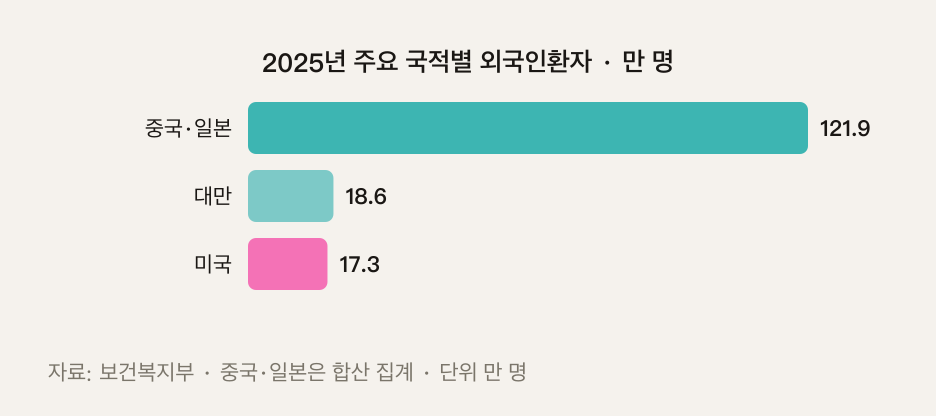
According to MOHW data, the composition of foreign patients by nationality in 2025 showed China and Japan combined accounting for 1.219 million, or 60.6%. Taiwan saw 186,000 patients (9.2%), an increase of 122.5% year-on-year, while China increased by 137.5%. The United States accounted for 173,000 patients. This data released by the MOHW does not separately list Hong Kong. By medical specialty, dermatology accounted for 1.313 million patients (62.9%), plastic surgery for 11.2%. The proportion of patients using clinic-level medical institutions was 87.7%, and the proportion attracted to Seoul was 87.2%.
What Remains Unconfirmed
We also clarify what this article could not answer. This publication could not find any regularly published data on the annual number of detections, accusations, or dispositions related to unregistered patient attraction. The only enforcement statistic obtained is from a 2015 crackdown, where 31 suspects were booked, 25 cases ended in no charges or suspended indictments, and 6 individuals were punished. This figure, reported by Medigatenews on October 16, 2018, citing parliamentary office and Korea Health Industry Development Institute data, is ten years old and cannot represent the current situation.
Therefore, this article does not state that 'unregistered brokering is increasing.' What has been confirmed is that the market has grown approximately 17-fold from its 2020 low, and what the law regulating this market stipulates and what it does not. While claims circulate on social media that unregistered individuals are increasingly introducing hospitals, this publication has not found public statistics or primary sources to support this.
The system will change once more. Act No. 21693, promulgated on May 26, 2026, will take effect on May 27, 2027. Its main points include establishing a basis for non-face-to-face medical treatment for foreign patients, expanding the scope of overseas healthcare expansion reporting, and creating a basis for status surveys. This amendment does not include strengthened penalties for unregistered brokering.
※ This article is for informational purposes only and is not an advertisement for specific medical institutions or procedures. The decision to undergo a procedure and its effectiveness may vary by individual; please consult sufficiently with medical professionals before making a judgment.