Taiwanese broadcasters TVBS News and TTV News (台視新聞) reported on July 22, 2026, a claim by a Taiwanese woman who stated she developed up to 15 nodules on her forehead and jawline after receiving collagen biostimulator injections at a Korean aesthetic clinic in May of the same year.
According to the woman's account, as summarized by the two media outlets, she underwent the procedure in Korea on May 10. Initial post-procedure nodules subsided three to four days later. After returning to Taiwan on May 13, she experienced swelling and inflammation starting May 16, and by May 25, lumps formed on her forehead. The woman stated that the nodules had not disappeared by early July.
Online in Taiwan, this case was discussed alongside other unrelated issues, including claims that Korean regulatory bodies had released a list of aesthetic clinics. This article cross-references publicly available data from Korean and Taiwanese regulatory agencies and peer-reviewed academic literature to differentiate confirmed facts from unconfirmed claims in this matter.
What are Nodules?
At the center of the controversy is a product category known as 'collagen biostimulators.' Unlike hyaluronic acid (HA) fillers, which immediately add volume upon injection, polylactide-based products (PLLA·PDLLA) use biodegradable polymers to stimulate fibroblasts, promoting the body's own collagen production over several months. A characteristic of this category is the gradual formation of volume.
The category itself is not new. PLLA was approved in Europe under the name NewFill and then by the U.S. FDA in 2004 for treating HIV-related facial lipoatrophy. It later gained approval for aesthetic indications as Sculptra, accumulating over 20 years of clinical use.

Nodules are a well-known adverse reaction in this product category, as documented in literature, and represent the most common type of complication. A 2025 systematic review, which compiled data from 117 patients and 40 studies, reported that 82.91% of complications were nodules, followed by edema (9.40%) and lumps (3.42%). This scoping review indicates that delayed nodules and granulomatous reactions account for 8.3% of all filler-related adverse reactions.
The timing of their appearance typically follows a bimodal pattern. A scoping review published in June 2026 describes early reactions generally occurring at 4–8 weeks, while delayed reactions are concentrated after 6 months. Clinical manifestations are also categorized into four types: non-inflammatory, inflammatory/immune, infectious/biofilm, and other atypical forms.
One crucial difference to note is that while nodules caused by HA fillers can be dissolved with hyaluronidase, this method is ineffective for polylactide-based nodules. This means the common understanding of 'if there's a problem, just dissolve it' for fillers does not directly apply to collagen biostimulators.
Related cases have also been reported in peer-reviewed journals in Korea. A case published in the Archives of Aesthetic Plastic Surgery in 2024 described a 58-year-old woman who developed firm, non-tender granulomas under both eyes two months after her third PDLLA injection to improve undereye hollowness. Intralesional trichloroacetic acid (TCA) injections and IPL treatment were ineffective, ultimately requiring surgical excision under local anesthesia. Even after surgery, small residual nodules remained in the inner corners of both eyes, necessitating additional triamcinolone injections. The paper noted that while PDLLA is known to have a lower risk of granuloma than PLLA, it can still occur.
Literature also provides guidance on diagnosis and management. High-frequency ultrasound (HFUS) at 15–22 MHz has high sensitivity for diagnosis, and persistent or atypical lesions require biopsy and pathological examination for definitive diagnosis. Treatment follows a stepwise approach based on severity: mild cases are managed with observation and massage, moderate cases with intralesional triamcinolone, and severe cases with steroids plus 5-FU, with immunomodulators if necessary. Surgical excision is a last resort for persistent, fibrotic nodules unresponsive to other methods. The same review specifies that if infection or biofilm is suspected, culture testing should be performed before administering steroids or immunosuppressants.
Incidence Rates Driven by Preparation and Technique, Not Product Itself
Literature consistently points to preparation and technique, rather than the product itself, as key variables. A June 2026 scoping review concluded that, based on current scientific evidence, proper dilution, correct hydration, accurate injection depth, and avoiding bolus (excessive volume at one point) injection are the 'most important modifiable factors.'
PLLA is supplied as a lyophilized powder and must be diluted with sterile water and hydrated before injection. Early practices often used only 2–3 mL of sterile water, and studies from that period reported very high nodule incidence rates under these conditions. Currently, the recommended dilution is approximately 8–10 mL per vial for facial areas and 16–18 mL or more for body areas. A PDLLA expert consensus recommends using 7–8 mL of sterile water for injection, allowing it to stand for 10–30 minutes, and then manually agitating it.
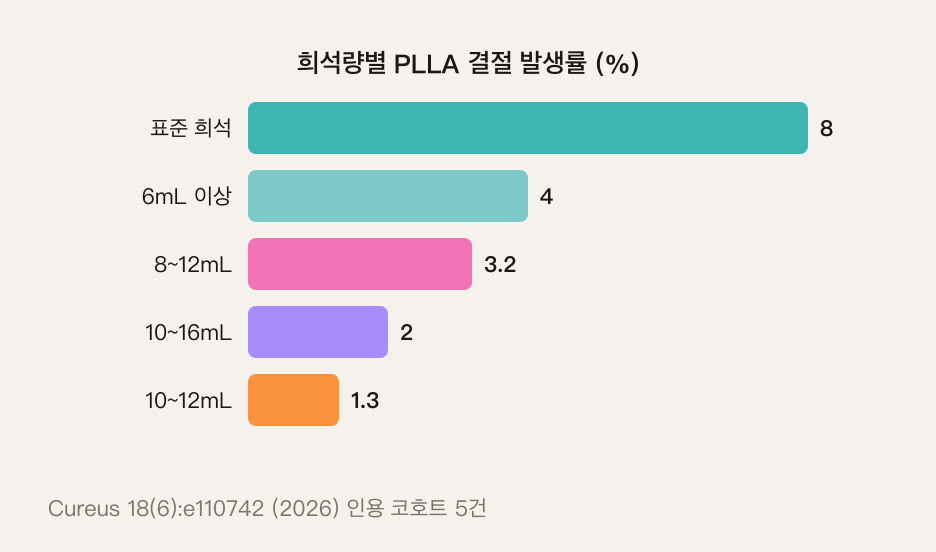
Statistics support this. In a 2021 chart review of 150 patients, the nodule incidence rate for the standard protocol was 8%, but it dropped to 1.3% in the group diluted with 10–12 mL. Other cohorts using increased dilution volumes reported rates ranging from 2.0% to 4.0%. This indicates that even with the same ingredients and product category, incidence rates can vary several-fold depending on preparation conditions.
Similar observations have been made in Korean clinical settings. At a discussion on anti-aging procedure side effect management hosted by the medical journal Medical Times in January 2024, practitioners identified three conditions leading to nodule formation: improper dilution, shallow layer injection, and excessive (bolus) injection. However, no single preventative measure is a complete solution. The scoping review also cited research indicating that post-procedure massage alone was insufficient to prevent nodules without proper dilution and injection techniques.
The same scoping review also highlights differences in risk by anatomical area. It notes that particular caution is required in areas with high movement or anatomical risks, such as the periorbital region, temples, glabella, nasolabial folds, and mental crease.
One internal statistic from Korean clinical practice has also been disclosed. According to 10 frequently performing medical professionals in Korea in April 2025, among approximately 40,000 procedures, there were 26 cases of nodules, a rate of 0.065%. However, this is a self-reported figure shared by the practitioners, not a peer-reviewed cohort study, and should not be given the same weight as academically verified data.
Time Lag Between Procedure and Symptoms
Another factor complicating causality assessment is the time elapsed between the procedure and the onset of symptoms.
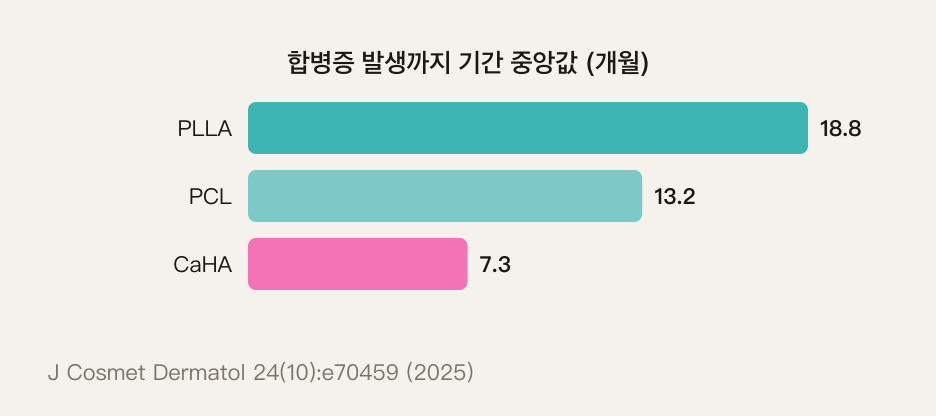
In the aforementioned systematic review, the median time to complication onset varied significantly by filler type: PLLA 18.75 months, PCL 13.20 months, CaHA 7.35 months. The same paper also reported PMMA at 35.34 months and dextran microspheres at 2.33 months. The distribution of foreign body granuloma cases by filler type in this study was PMMA 35.04%, PLLA 30.77%, CaHA 27.35%, and PCL 4.27%. This indicates that nodules and granulomas are a general issue across this category of products, not limited to a single product, and also that the long interval between procedure and symptoms makes it difficult to determine causality in individual cases.
Regulatory Status — Korea and Taiwan
In Korea, this product is regulated as a medical device, not a pharmaceutical. For Juvelook (쥬베룩), which was mentioned in the Taiwanese reports, the manufacturer's disclosed approval information lists its product name as 'Tissue Restoration Material' and its classification as a Class 4 medical device. Its approved purpose is the temporary improvement of facial wrinkles in adults by injecting polylactide and hyaluronic acid subcutaneously for physical restoration. Thus, the approval documentation itself presupposes 'temporary improvement.'
The product is also officially approved in Taiwan. According to a public notice from Taiwan's Ministry of Health and Welfare, Food and Drug Administration (TFDA) on December 3, 2025, the approval number is 衛部醫器輸字第037021號, the Chinese product name is 「芳蜜」喬雅露軟組織注射植入物, and the applicant is 沃醫學股份有限公司. The same notice urged medical institutions and personnel to adhere to the approved instructions, which already include a warning 'prohibiting injection in the periorbital (eye socket) area.'
However, it was not specified which formulation within the same brand was used. The Taiwanese report only referred to it as the 'blue bottle' (藍瓶).
Two Unrelated Issues Circulating with This Case
First is the TFDA's safety warning issued on December 3, 2025. The impetus for this notice was not the 2026 Taiwanese woman's case but another incident reported in 2023. The notice stated that 'in Poland, on July 3, 2023, Juvelook (lot number VJ220511) was injected into the periorbital area, resulting in significant hypertrophy (deposition, nodules) adverse reactions.'
The manufacturer's investigation results were also included in the notice. The problematic product was distributed through an unauthorized channel, and its UDI code and printing format differed from genuine control samples. The manufacturer determined the reported product to be counterfeit and not produced by them. The Taiwanese distributor stated that they had not imported the product mentioned in the warning. Meanwhile, the same notice also included a point from the Polish competent authority, which stated that 'the Juvelook Instructions for Use (IFU) do not clearly describe the areas where this medical device should be injected, and there is insufficient distinction between safe and unsafe areas.'
In summary, there is no basis to link this warning causally to the current case of the Taiwanese woman. The timing (2023 reported incident vs. May 2026 procedure), product (counterfeit lot not imported into Taiwan), and areas (periorbital vs. forehead and jawline) are all different. The two incidents are separate.
Second is the claim that 'Korea blacklisted 15 aesthetic clinics.' This is false. What was actually announced in Korea in July 2026 was that the Fair Trade Commission had corrected six types of unfair contract clauses in the prepaid treatment terms and conditions of 15 dermatology and aesthetic clinics. The focus was on consumer contract clauses such as restrictions on prepaid refunds and contract termination conditions, and it was unrelated to procedure safety or adverse reactions.
Details of the reported action show that 13 clinics had clauses restricting contract cancellation or termination, 10 clinics each had clauses prohibiting lawsuits and restricting the transfer of prepaid treatment rights, 7 clinics had clauses exempting business liability, and 2 clinics had clauses specifying excessive penalty fees. Following the correction, clinics agreed to refund the remaining balance after deducting the cost of already performed procedures and a 10% penalty fee in accordance with consumer dispute resolution standards.
Although these two issues circulated together around the same time, no Korean media reports linking this measure to procedure safety were found during our review.
What Remains Unconfirmed
We also note what remains unconfirmed. The following four points are items for which judgment is reserved at the time of writing this article:
- Cause of the nodules: A non-party physician mentioned in the Taiwanese report suggested the possibility of an immune or allergic reaction due to issues in the manufacturing or preparation process, but this is a presented possibility, not a confirmed conclusion. The Taiwanese distributor stated that the product is a legal medical device in Taiwan and that no adverse event reports have been filed, but this claim cannot be independently verified as Taiwanese authorities do not disclose product-specific reporting numbers.
- Outcome of the case: The narratives from the two Taiwanese media outlets diverge. One reported the woman's claim that the Korean clinic delayed treatment appointments and then ceased communication, while the other stated that an agreement was reached with the Korean clinic for insurance compensation. Neither account has been independently verified.
- Coverage by established Korean media: No Korean media reports covering this specific case were found through Korean-language searches. This does not prove that such reports do not exist.
- Response from Korean regulatory authorities: This investigation did not confirm any safety letters, recalls, or similar actions taken by the Korean Ministry of Food and Drug Safety regarding this product category. This also does not prove that no such actions were taken.
Official Channels for Assistance in Case of Issues
- Application for mediation with the Korea Medical Dispute Mediation and Arbitration Agency (K-MEDI): Foreign patients can also apply. Applications can be submitted online, by mail, or fax. Required documents include the mediation application form and appendix, consent form for collection/use of personal (sensitive) information, a copy of identification, a copy of bank account details, a copy of medical records, and imaging data.
- Conditions for initiating the process: The process begins if the medical institution involved expresses its intent to participate within 14 days of receiving the mediation application. For cases involving death, unconsciousness for over one month, or severe disability, the process automatically begins without the other party's consent. The application fee is 22,000 KRW for claims up to 5 million KRW.
- Mediation decision deadline: A mediation decision is made within 90 days of the process initiation and can be extended once for up to 30 days if necessary. If both parties agree to the official mediation decision, it holds the same legal effect as a court settlement.
- Medical Korea Information Center: This center is jointly operated by the Ministry of Health and Welfare and the Korea Health Industry Development Institute (KHIDI). It relocated to B2, Seoul Station, 378 Cheongpa-ro, Yongsan-gu, Seoul in January 2025. It provides one-stop assistance, from medical dispute counseling to support for K-MEDI applications, medical interpreter connections, reporting illegal patient recruitment for foreign patients, and guidance on VAT refunds for cosmetic and plastic surgery. The main contact number is Medical Call 1577-7129, with support available in English, Chinese, Japanese, and Russian. The mediation and arbitration process itself is conducted by K-MEDI.
- Pre-procedure verification: In Korea, medical institutions must be registered to attract foreign patients. The 'Act on Support for Overseas Expansion of Healthcare and Attraction of Foreign Patients' stipulates that anyone who attracts foreign patients without registration is subject to imprisonment for up to 3 years or a fine of up to 30 million KRW. The Foreign Patient Attraction Information System, operated by KHIDI, allows users to check the registration status of institutions and report illegal recruitment.
- Taiwanese channels: If issues related to products or distribution are found in Taiwan, reports can be made to the National Adverse Drug Reaction Reporting Center (全國藥物不良反應通報中心) (phone: 02-2396-0100). The TFDA has instructed medical institutions to purchase and use products with valid licenses from legitimate medical device vendors to ensure safety.
※ This article is for informational purposes only and is not an advertisement for any specific medical institution or procedure. The decision to undergo a procedure and its effectiveness may vary by individual. Please consult thoroughly with medical professionals before making a decision.